Photo via Fast Company
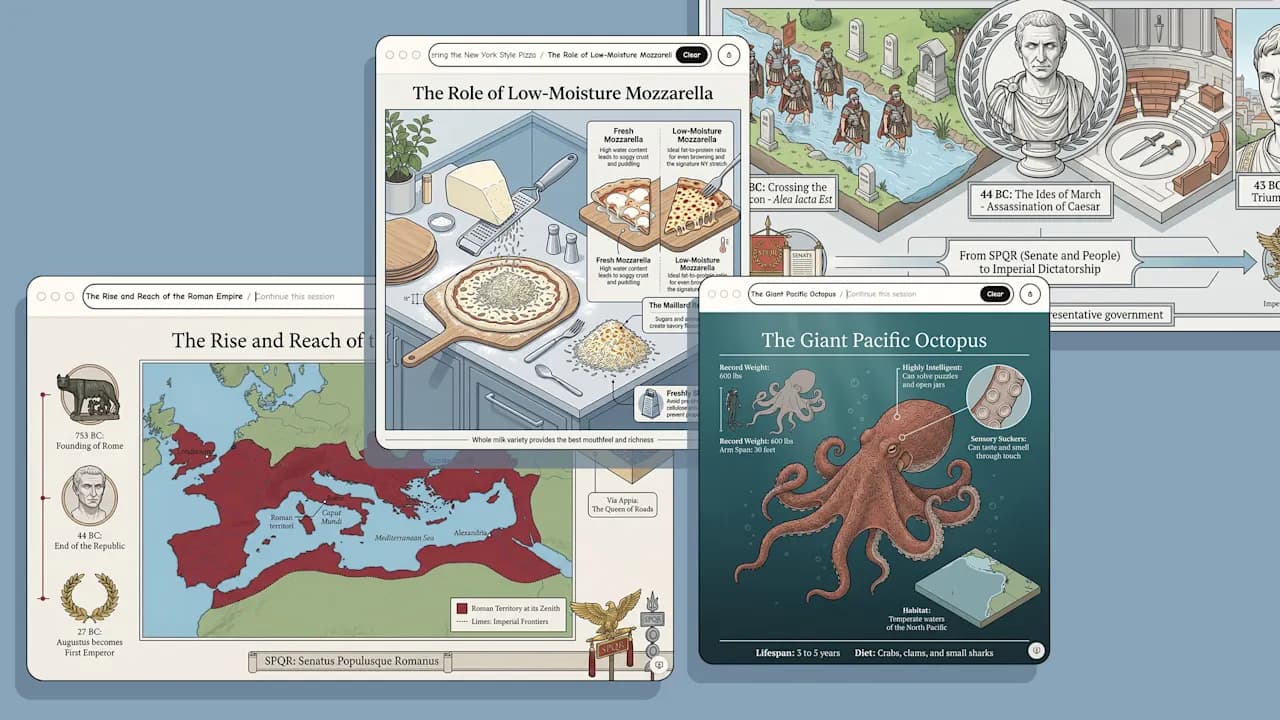
Flipbook, a prototype browser developed by former OpenAI researchers, represents a fundamental departure from the chat-based AI interfaces that have dominated the market since ChatGPT's launch. Rather than requiring users to compose detailed text prompts and parse lengthy responses, Flipbook generates illustrated pages on demand—each one clickable and explorable. According to Fast Company, the interface treats knowledge as a spatial landscape to navigate rather than a database to query, letting users discover information by clicking on specific visual elements to drill deeper.
The platform echoes Apple's legendary HyperCard software from 1987, but with AI-powered generation happening in real time. Where HyperCard required human designers to manually create and link each illustrated card, Flipbook's AI analyzes what users click on and generates relevant detailed content instantly. The system renders everything as pixel-based images—text, buttons, and graphics—streamed directly to the screen without traditional HTML or browser code, creating a fundamentally different computing experience than the web-based tools most Atlanta businesses rely on today.
For corporate applications, Flipbook's approach could reshape how companies handle research, training, and customer education. The creators envision expanding the platform to support interactive tasks like trip planning or product research entirely within the visual canvas. However, the prototype still carries accuracy limitations typical of large language models; according to the development team, users should expect the same level of factual reliability as existing AI systems, with improvements expected as underlying models advance.
What makes Flipbook noteworthy for Atlanta's business community is its signal about AI's future direction: away from text-based outputs toward experiential interfaces. The platform suggests that the next wave of AI adoption may prioritize intuitive visual understanding over raw information volume—a shift that could impact how professional services, design firms, and tech companies in the region approach client deliverables and internal workflows over the next few years.