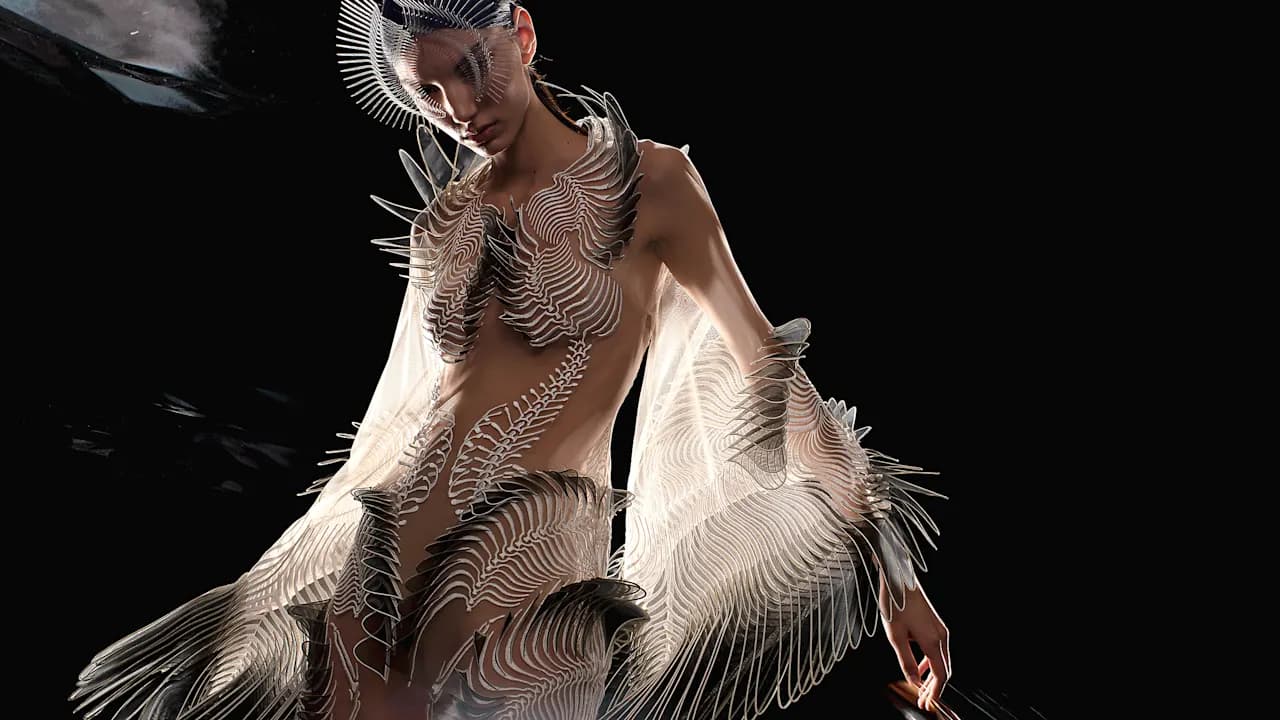
Photo via Fast Company
Dutch couture designer Iris van Herpen is redefining what fashion can be by treating science as a creative partner rather than an afterthought. Her retrospective, "Sculpting the Senses," opens at the Brooklyn Museum on May 16 and represents the North American debut of a show that has traveled globally from Paris to Brisbane to Singapore. The exhibition showcases two decades of work that integrates biomimicry, 3D printing, and collaboration with paleontologists, architects, and biologists to create pieces that blur the line between wearable art and scientific exploration.
Van Herpen's approach offers a striking counterpoint to current industry trends. While the global fashion industry generates 92 million to 100 million tons of textile waste annually and mainstream brands increasingly rely on AI-generated lookbooks and ultrafast production cycles, Van Herpen maintains an entirely handmade couture practice. According to Fast Company, she produces limited pieces through extended, meditative processes—a single bubble dress worn at the 2026 Met Gala took 2,550 hours to construct from 15,000 hand-formed glass bubbles. For Atlanta's growing fashion and design sectors, Van Herpen's model suggests an alternative path focused on sustainability and craftsmanship over volume.
The Brooklyn exhibition demonstrates fashion's evolving relationship with scientific inquiry and natural systems. Van Herpen's collections draw inspiration from water in all its states, fish scale architecture, spider webs, and even coral systems—a practice called biomimicry that transforms scientific observation into textile innovation. The show includes an 80-million-year-old ichthyosaur skeleton displayed alongside bone-inspired couture, courtesy of a partnership with the American Museum of Natural History. This fusion of natural history and fashion design may inspire Atlanta institutions and designers to explore similar cross-disciplinary collaborations.
Perhaps most radically, Van Herpen's work challenges the fashion industry's obsession with speed and scale. A new video installation in the Brooklyn show projects the invisible labor of her atelier—hand placement, needle catches, slow embroidery accumulation—onto 25-foot screens in real time, celebrating the meditative process behind couture creation. In an industry increasingly pressured toward automation and rapid turnover, Van Herpen's insistence on slow, deliberate craftsmanship offers Atlanta's luxury and independent fashion makers a compelling model for differentiation and sustainability in an accelerating market.